Collagen Powder Filling Accuracy Starts With a Written Weight Tolerance
Collagen Powder Filling Accuracy Starts With a Written Weight Tolerance
- A 0.20 g difference represents 4% of a 5 g target, 2% of 10 g, and 1% of 20 g.
- Record targets in grams and percentages. Measure samples at startup, during the run, and after a change in conditions.
- For applicable powder packs, Lifeworth uses a 21-day screen at 45 °C and 85% RH to look for moisture-related changes.
Set the tolerance at the selling unit
Collagen powder can change bulk density as it settles in the hopper. Humidity can also change flow. On a volumetric fill, the same machine setting can then deliver a different net mass. Specify how a checkweigher or calibrated balance will measure the result.
Calculate the percentage at your nominal fill
The fixed 0.20 g difference shows how serving mass changes the calculation. Set contractual and legal acceptance criteria separately for the actual product and market.
| Target | Weight difference | Relative difference |
|---|---|---|
| 5.00 g | 0.20 g | 4.0% |
| 10.00 g | 0.20 g | 2.0% |
| 20.00 g | 0.20 g | 1.0% |
Take samples where powder behavior changes
For an applicable powder project, Lifeworth uses a 21-day screen at 45 °C and 85% RH in the intended pack. Agree on acceptance limits before the test and record caking, dispersion, and seal condition alongside any required assay. Use the full stability plan to support shelf life.
For single-serve units, record individual net weights and reject decisions. For a multi-serve pouch, check both the declared pouch net weight and the practical serving instructions. Review variance after a hopper refill, a stoppage, or a humidity shift.
21 CFR 111.70 on specifications · 21 CFR 111.75 on determining whether specifications are met
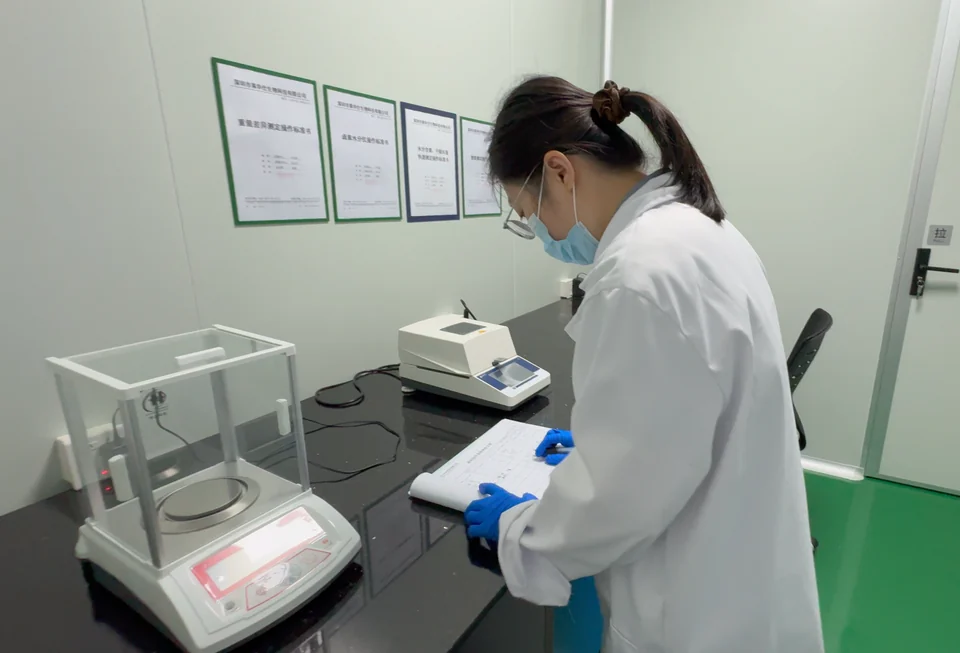
A technician records a check beside a Lifeworth precision balance. For powder fills, log individual net weights after startup and whenever hopper refills or line stops can change the weight distribution.
Approve the checks before releasing the label
Record both targets with the actual package and market.
Agree on the fill tolerances, sampling intervals and actions for drift.
Confirm grade, source, bulk density and relevant allergen documents.
Request lot COA, fill records, seal checks and any deviation disposition.
Send the nominal fill, number of servings, collagen grade and pack drawing for a filling trial scope. For eligible projects with approved specifications and available materials, Lifeworth can target 3 days for samples, 25 days for a first order, and 15 days for a repeat order. Confirm dates against the agreed scope.
Frequently asked questions
Does a 0.20 g tolerance work for every SKU?
Set limits from the actual nominal mass, process capability, labeling requirements and applicable market. The table illustrates the relative difference only.
What should QA do after the hopper is refilled?
Check for a step change in fill distribution. Record the refill time and any adjustment or segregation of units.
Can a scoop replace a scale for release checks?
Use a calibrated weight measurement for net fill. Scoop tests are useful for checking how the consumer is likely to portion the powder.
Which powder properties can alter filling accuracy?
Track bulk density, clumping and flow. A change in particle or moisture behavior can move the weight even if the machine setting stays fixed.